
Trekking in Mardi Himal 2026 | 5-Day Itinerary and Price
Inside this guide: Find the Mardi Himal Trek itinerary, per-person costs, a trek map, details on who the trek is right for, and essential pre-trek information.
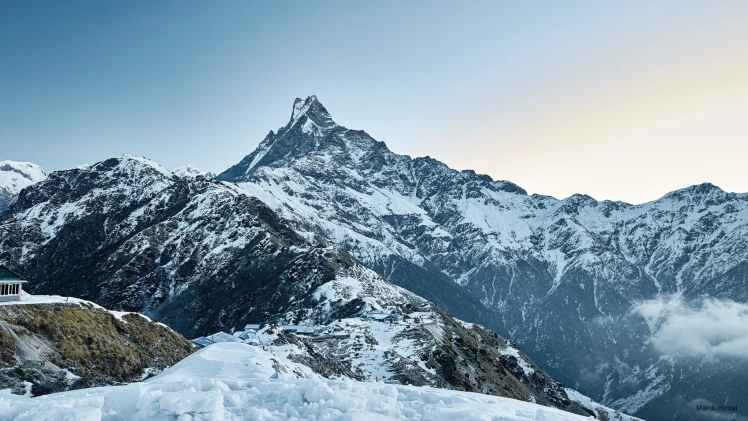
The Mardi Himal Trek is a short, multi-day trail that guides trekkers to the base camp of Mardi Himal. This route offers spectacular Himalayan views of Annapurna South, Hiunchuli, and the iconic Machhapuchre (Fishtail Mountain). It is particularly popular among those trekkers with limited time, providing direct access to high-altitude vistas within just four days of ascent.
The trail ascends rapidly through the lush Annapurna Conservation Area, beginning at Dhampus. Along the way, trekkers pass through small settlements such as Forest Camp, Low Camp, Badal Danda, High Camp, and Siding Village. The main highlight of the trek is the breathtaking sunrise from Mardi Himal Base Camp, where the first sunlight casts a golden glow over Annapurna South.
Join our short and accessible Mardi Himal Trek for spectacular, close-up Himalayan views of the Annapurna Massif and Mount Fishtail. You will walk on verdant hills, meet other friendly trekkers, and complete 4,500 meters trek within five days.
Mardi Himal Trek Cost
USD 275 / person
| No. of people | Price per person |
|---|---|
| 2 Pax | USD 299 |
| 3 to 5 Pax | USD 275 |
| 6 to 9 Pax | USD 250 |
| 9 to 12 Pax | USD 225 |
Speak to An Expert
Cost Includes and Excludes
Cost Includes
- Local bus transfer Pokhara to Dhampus
- Local Jeep Transfer Siding to Pokhara
- Accommodation in Twin-sharing Basis in Mountain Lodges
- Local English Speaking Guide for 5 days
- Annapurna Conservation Area Permit
- Trekking Map, Sun Hat, Duffel Bag
- Trip completion certificate
- Government Taxes
Cost Excludes
- Porter service for 6 days (optional – extra USD 100 per porter). One Porter can carry 2 trekkers load (24 kg)
- Meals (breakfast, lunch, and dinner) during the trek – around USD 15 to USD 20 Per Day Per Person
- Travel insurance, including high-altitude emergency evacuation coverage
- Any beverages, including bottled or boiled water
- Tips for trekking staff and driver
- Personal trekking gear and equipment
- Hot showers, Wi-Fi usage, and battery charging
- International Payment Bank Charges
- Helicopter cost for rescue
- Any expenses not mentioned in the Includes section
Why Our Trekking Packages Exclude Meals?
Travel To Nepal does not include meals in our standard trek packages to guarantee menu choice for trekkers. Fixed packages often limit trekkers to specific, pre-set meals. Meals-not-included policy allows trekkers to order based on their daily appetite and pay teahouse owners directly. Direct payments support the local economy while reducing food waste.
Policy Benefits and Logistics
- Dietary Flexibility: Trekkers select meals based on daily appetite and physical condition. This freedom allows hikers to adjust intake as digestion fluctuates with altitude changes.
- Direct Local Support: Cash payments go immediately to the families managing the lodges. This direct transaction supports the complex logistics of transporting ingredients via mules and porters.
- Cost Transparency: Daily food expenses average USD 15 to USD 20 per person. Prices correlate directly with elevation; menu costs increase at higher stops like High Camp and Badal Danda due to transport fees.
Mardi Himal Trek Itinerary 5 Days
We designed this Mardi Himal itinerary to match the daily walking capacity of average trekkers with the locations of available well-established teahouses. The schedule includes extended breaks at the Upper Viewpoint (4,200m) for sunrise viewing. This pacing allows trekkers to enjoy the trek without rushing.
Day 1: Drive from Pokhara city to Dhampus Village. Trek to Forest Camp
Day 1: Drive from Pokhara city to Dhampus Village. Trek to Forest Camp
Highlights
- Walk through the forest of rhododendron, maple, mountain oak, and hemlock.
- Pass through traditional Gurung village with slate-roofed houses and paved courtyards in Dhampus
Private jeeps transport trekkers from Pokhara (822m) to Dhampus Village (1,650m) in approximately 1.5 hours. This drive connects the urban center of Pokhara to the southern ridge of the Annapurna Conservation Area. Dhampus serves as the primary trailhead. The trail ascends from Dhampus on stone staircases to Pothana (1,890m). Trekkers register their Annapurna Conservation Area Project (ACAP) permits at the Pothana checkpoint. The route continues upward to Deurali (2,100m). Deurali functions as a junction point where the trail splits from the Annapurna Base Camp route.
The path to Forest Camp (2,550m) diverges east from Deurali. This section enters a dense, quiet ecosystem distinct from the lower agricultural villages. The trail climbs through mixed temperate forests containing rhododendron, maple, mountain oak, and hemlock trees. Gaps in the forest trees offer views of Machhapuchhre (Fishtail) and Annapurna South. Locals refer to Forest Camp as “Kokar.” The trek from Dhampus to Forest Camp covers a distance of roughly 10 kilometers and requires nearly 7 hours of walking. Tea houses in Forest Camp provide accommodation and meals for the trekkers.
Day 2: Trek from Forest Camp to Badal Danda
Day 2: Trek from Forest Camp to Badal Danda
Highlights
- First unobstructed views of Machhapuchre and Annapurna South
- Trekkers hike above the clouds and view a spectacular scene of ‘sea of clouds’ below.
The trail ascends from Forest Camp (2,550m) to Badal Danda (3,210m). This section connects the temperate forest zone to the subalpine ridge of the Mardi Himal route. The path climbs steeply through dense rhododendron, birch, and mountain oak trees. Moss and lichen cover the tree trunks in this humid section. Trekkers reach Low Camp (2,970m) after approximately four hours of continuous ascent. Low Camp serves as an intermediate checkpoint with teahouses for lunch and water.
The route ascends vertically after Low Camp. It takes around an hour to reach Badal Danda from Low Camp. Badal Danda, or “Cloud Hill,” sits on an exposed section of the Mardi trail ridge line. This location provides clear view of Machhapuchhre, Annapurna South, and Hiunchuli. Accommodation at Badal Danda consists of lodges that rely on solar power for electricity. Clouds frequently move across the ridge in the late afternoon, limiting visibility to the immediate trail.
Day 3: Trek from Badal Danda to High Camp
Day 3: Trek from Badal Danda to High Camp
Highlights
- Continuous view of mountains along the trail.
- Walk along the green and brown meadows.
The trail proceeds north from Badal Danda along the treeless Mardi Himal ridge. Short grasses, mosses, and rosette plants dominate the landscape. Trekkers cover the 2.6-kilometer distance to High Camp (3,580m) in approximately 3 to 4 hours. The route involves a steady, moderate ascent with occasional steep rocky sections.
High Camp functions as the final settlement before the Mardi Viewpoint and Mardi Himal Base Camp. Lodges here sit on a narrow pasture directly beneath the south face of Machhapuchhre. This proximity provides detailed visibility of the mountain’s fluted ice ridges. To the west, Annapurna South and Hiunchuli dominate the horizon. The altitude results in cooler temperatures and thinner air compared to lower villages. Trekkers frequently observe the Himalayan Monal (Danphe), Nepal’s national bird, foraging on these high-altitude slopes. Clouds typically envelop the ridge by mid-afternoon, requiring morning travel for optimal visibility.
Day 4: Early Morning hike to Mardi Himal Base Camp. Descend to Low Camp
Day 4: Early Morning hike to Mardi Himal Base Camp. Descend to Low Camp
Highlights
- Golden Sunrise view from Mardi Himal View Point.
- Beautiful Golden Hour Sunlight Reflection on Annapurna South, Hiunchuli, and Machhapuchhre
- Reach the Highest Point of the trek to Mardi Himal Base Camp
Trekkers begin the ascent from High Camp at 4:00 AM. Headlamps illuminate the steep, narrow trail along the ridge line. The path climbs continuously towards the Upper Viewpoint (4,200m). Hikers reach this vantage point in approximately two hours. The sunrise illuminates the south face of Machhapuchhre, Annapurna South, and Hiunchuli. This early morning lighting gives the snow-capped peaks a distinct golden color. The trail continues for another hour along the exposed ridge to Mardi Himal Base Camp (4,500m).
Mardi Himal Base Camp functions as the highest elevation point of the trek. This location sits directly at the base of the Machhapuchhre rock face and Mardi Himal. Trekkers view the Annapurna Sanctuary glaciers and the expansive lowers green hills from this position. The return route retraces the path back to High Camp for a brief rest and lunch. The descent continues downward, dropping elevation rapidly. The trail re-enters the forest zone below Badal Danda and finishes the day at Low Camp. This segment covers approximately 17.2 kilometers and requires about total 9 hours of trekking.
Day 5: Trek from Low Camp to Siding. Drive to Pokhara
Day 5: Trek from Low Camp to Siding. Drive to Pokhara
Highlights
- Hike downhill along the traditional villages of Nepal.
The trail descends sharply from Low Camp (2,970m) towards Siding Village (1,700m). This specific route separates from the ascent path at Low Camp, directing trekkers into the deep valley of the Mardi Khola. Trekkers navigate stone steps covered in moss and leaf litter. Trekkers reach Siding Village after approximately 3 hours of continuous descent. Siding is a traditional Gurung settlement from which most trekkers exit Mardi Himal route.
Jeeps take trekkers from Siding Village back to Pokhara (822m). The drive covers a distance of approximately 32.3 kilometers. Vehicles move in a rough, unpaved agricultural road for the first hour, passing through the villages of Lwang and Ghachok. These areas feature extensive terraced millet and rice fields. The route joins the paved Baglung Highway at Lumre. The vehicle proceeds southeast for another hour to reach the hotel district in Lakeside, Pokhara.
Congratulations, you have completed the Mardi Himal Trek. You have seen close-up, breathtaking views of Annapurna South and Machhapuchhre. If you would like to extend this tour with another trek or spend some leisure time on a Chitwan Jungle Safari, we would be more than happy to arrange it for you.
Mardi Himal Trek Map
We have built a custom Mardi Himal Trek map to help trekkers navigate the Mardi Himal trail. This trek has many route options, but for this map, we have chosen a specific route that is relatively easy to walk and offers better mountain and landscape views.
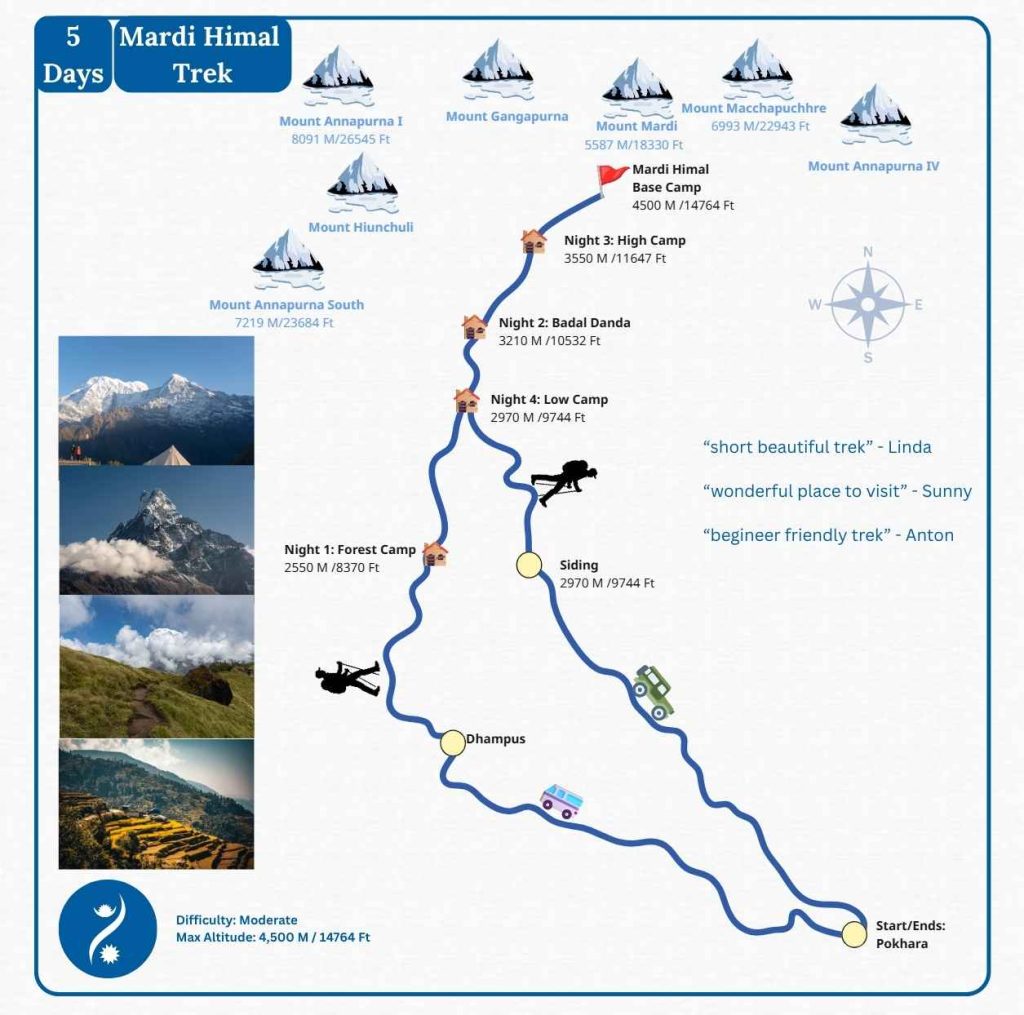
This Mardi Himal Trek map illustrates the 5-day itinerary. The route connects Pokhara to the villages, such as Dhampus, Forest Camp, Low Camp, Badal Danda, High Camp, and Siding. Specific labels indicate the elevation for each village. The map identifies adjacent peaks, specifically Machhapuchhre, Annapurna South, Hiunchuli, and Annapurna I. The map matches the trekking schedule.
Who is Mardi Himal Trek Suitable For?
The Mardi Himal Trek is right for trekkers with limited 4-to-5-day time. The itinerary specifically suits individuals seeking high-altitude trekking with immediate, close-range sightlines of Himalayas. This route is also right for social hikers who like to meet and interact with diverse groups of people on the trail. Please note that limited lodge capacity requires trekkers be comfortable with shared sleeping quarters during peak seasons. Additionally, the trail ecosystem appeals to trekkers who prefer walking through dense, verdant forests rather than arid landscapes.
- Short Duration High Altitude Trekking: The 5-day itinerary reaches a maximum elevation of 4,500 meters at Base Camp. This schedule provides immediate, close-range views of Machhapuchhre and Annapurna South without a multi-week commitment. High altitude on Day 3 and Day 4 increases the risk of Acute Mountain Sickness (AMS). Trekkers mitigate this risk through hydration and strict acclimatization protocols.
- Beginner Friendly: This route suits novice trekkers due to manageable daily walking distances. The itinerary distributes the vertical gain to minimize physical fatigue. The terrain consists primarily of constructed stone staircases and packed earth trails. Specific sections near High Camp feature steep, narrow ridges that require careful footing to maintain traction and safety.
- Moderately Crowded: Peak seasons (Spring and Autumn) attract high volumes of trekkers, which eliminates isolation on the trail. Communal dining halls in teahouses facilitate interaction between diverse groups of people. High occupancy rates sometime necessitate shared accommodation.
- Verdant Trail: Forest ecosystems cover approximately 70% of the total route distance. The path goes through dense trees of oak, maple, and hemlock. Rhododendron arboreum blooms create extensive canopy color during March and April.
Why Choose Travel To Nepal?
Connecting you directly to the heartbeat of the Living Land through authenticity, safety, and active guardianship.
Special Moments
Our itineraries include cultural secrets and unrevealed activities to make your trek extra memorable.
Local Experts
Local guides from Sherpa, Tamang, Lama, Newar, and Chhetri communities lead every trek with deep local knowledge.
Seamless Service
Dedicated staff handle all permits and logistics to ensure a frictionless travel experience.
Active Guardianship
Our “Guarding the First Living Shangri-La” policy ensures that we protect our environment and local culture.
Custom Itineraries
We design personalized programs as per your preference, including arrangements for single guests.
Transparent Pricing
We have no hidden fees or forced add-ons included in our trek cost.
Table of Contents
What Are the Main Attractions of the Trek?
The main highlights of the Mardi Himal Trek include immediate, close-range views of the Himalaya and a sunrise at the Upper Viewpoint, where distinct, eye-catching golden light reflects off the mountain peaks. The route includes walking through dense rhododendron forests and sub-alpine ridges above 3,300 meters. Additionally, trekkers enjoy lively dining halls with fellow trekkers in teahouses.
- Mountain Visibility: The short itinerary provides immediate, close-range sightlines of Annapurna South, Hiunchuli, and Machhapuchhre.
- Seasonal Flora: Rhododendron arboreum forests bloom extensively along the trail during March and April.
- Sunrise Vantage: The Upper Viewpoint provides the golden sunrise view and golden hour sunlight reflection on Annapurna South, Hiunchuli, and Machhapuchhre.
- Cloud Views: Badal Danda (3,210m) sits above the condensation level, allowing trekkers to view a “sea of clouds” filling the valleys below.
- Social Interaction: Communal dining halls in teahouses facilitate direct interaction with diverse trekking groups.
- Forest Ecosystem: The lower trail traverses humid temperate forests featuring old-growth oak and hemlock trees covered in epiphytic moss and lichens.
#Personal-Experience: The beauty of our Himalayas is not just the snowy peaks. It is the humble feeling of standing before towering mountains that are much bigger than yourself and connecting to their spirit. It is a call that pulls you back, long after you have gone home. It is the kindness and warm smile of local people. The true gift of the Himalayas is the special moments that touch your soul and change you forever.
Key Points to Know Before Trekking Mardi Himal
You need to be informed about required valid ACAP permit and sufficient Nepali Rupees (NPR) in cash prior to departure for trek. Successful preparation requires verifying seasonal accommodation status, daily meal options, and current route conditions. Trekkers need specific gear suited for local weather patterns and reliable water purification systems. We highly recommend comprehensive travel insurance that covers high-altitude evacuation and Acute Mountain Sickness (AMS) treatment. Moreover, trekkers must review company policies and recent government regulatory updates to ensure full compliance.
Trekking Permits
Trekkers must carry a valid Annapurna Conservation Area Project (ACAP) entry permit. Checkpoints at Pothana and Low Camp legally mandate these documents for all trekkers.
Currency Requirements
Teahouses and shops along the trail accept only Nepali Rupees (NPR). ATMs do not exist during the trek, requiring trekkers to withdraw sufficient funds in Pokhara.
Accommodation Facilities
Lodges provide basic twin-bed rooms with shared bathroom facilities. Peak season (March–May and October–November) volume sometimes requires trekkers to share rooms.
Meal Availability
Teahouse menus standardize offerings to high-energy staples like Dal Bhat (rice and lentils), noodle soup, and boiled eggs. Kitchens cook meals to order, which results in wait times of 45 to 60 minutes during dinner service.
Weather Conditions
Trekkers should check forecasted weather in the local region from the Department of Hydrology and Meteorology and need to be aware of upcoming weather conditions for at least 7 to 10 days.
Route Conditions
The trail consists of stone staircases, packed earth paths, and exposed ridge lines. The final ascent to Base Camp involves steep, rocky sections that require careful footing and traction.
Internet Connectivity
Ncell and Namaste (NTC) cellular networks provide intermittent 4G coverage up to Badal Danda. WiFi availability in teahouses relies on solar power and frequently fails during cloudy weather.
Electricity
Teahouses rely on solar power for electricity, and it is not reliable on cloudy days. We recommend trekkers carry at least a 20,000 mAh power bank, or as required, to charge their devices for at least 2 to 3 days when electricity cuts off.
Water Availability
Trekkers should bring purification tablets or filtration systems for safe drinking water. Teahouses also sell boiled water, but we still recommend bringing purification tablets.
Gear and Clothing
Trekkers should check the weather forecast and pack their clothes accordingly. Cloudy, rainy, and winter seasons demand thick layering, while sunny and normal days do not require too much thick layering. Travel To Nepal will provide detailed packing requirements as per your plan. Crampons are not required for the Mardi Himal Trek. However, if there are chances of snowfall as per the weather forecast, we highly recommend bringing crampons.
Altitude Sickness
The elevation of 4,500 meters means the risk of Acute Mountain Sickness (AMS) shouldn’t be underestimated. Trekkers must adhere to acclimatization schedules and descend immediately if symptoms like persistent, severe headache or tightness or pain in the chest occur.
Company Policy
Trekkers should thoroughly read the payment, cancellation, and trekking policies of the company before finalizing the trek to ensure the company matches their requirements.
Government and ACAP Updates
Regulatory bodies occasionally modify trail routes or publish recent need-to-know information about the trek. We recommend following ACAP on Facebook and confirming with your company before embarking on the trek. Travel To Nepal will automatically inform all our clients if there are any unforeseeable changes by the government.
Insurance Coverage
Travel insurance policies must explicitly cover emergency helicopter evacuation up to 5,000 meters for Mardi Trek. Kindly note that standard medical plans frequently exclude high-altitude trekking activities.
Company Communication
Trekkers must disclose pre-existing medical conditions, dietary restrictions, and other essential information to the agency prior to booking. Clear confirmation of itinerary inclusions ensures accurate service delivery during the trek.
Facilities Available During the Mardi Himal Trek
The Mardi Himal Trek infrastructure consists of basic mountain lodges known as teahouses. These establishments provide essential amenities rather than luxury services. Kitchens prepare high-calorie staples, specifically Dal Bhat (rice and lentils), pasta, and potato dishes. Ingredients and variety differ significantly from the extensive menus found in urban centers like Pokhara. Bedrooms contain wooden beds with foam mattresses. Lodge owners supply heavy blankets to insulate against sub-zero nighttime temperatures. Solar panels generate electricity and power WiFi routers. Consequently, heavy cloud cover frequently interrupts internet connectivity and charging facilities.
Typical Meals, Menu Price and Food Quality
Trekkers in Mardi trail can choose from over 20 meal options served at teahouses across villages such as Forest Camp, High Camp, Badal Danda, and Siding.
Breakfast Options:
- Tea or Coffee (Rs 150)
- Boiled Egg (Rs 150)
- Muesli with Milk (Rs 500)
- Oat Porridge with Milk (Rs 500)
- Pancake with Jam or Honey (Rs 400)
- Pancake with Lemon Sugar (Rs 450)
- Chocolate Pancake (Rs 450)
- Millet Bread (Rs 500)
Lunch and Dinner Options:
- Mixed and Chicken Pizza (Rs 960 and Rs 1000, respectively)
- Dal Bhat (Rs 780)
- Egg Fried Noodles (Rs 680)
- Veg, Egg and Chicken Spaghetti (Rs 570, Rs 680, Rs 840, respectively)
- Veg, Egg and Chicken Macroni (Rs 570, Rs 680, Rs 840, respectively)
- Veg and Chicken Momo (Rs 530 and Rs 740, respectively)
- Veg Curry and Chicken Curry (Rs 340 and Rs 630, respectively)
Food Quality
Travel To Nepal prioritizes tea houses with high hygiene standards and high-calorie offerings. Guides inspect these kitchens during reconnaissance missions to minimize food safety risks. The selected lodges on the Mardi trail serve standardized menus containing necessary carbohydrates and proteins. We advise trekkers to consult their guide before ordering meals to ensure choices suit high-altitude digestion.
Dietary Tips for the Mardi Trek
- Avoid Meat: High-altitude environments reduce digestion power. Consuming meat increases the risk of gastrointestinal distress.
- Caloric Intake: Dal Bhat (rice and lentils) provides the most efficient energy source. This meal balances carbohydrates and fiber for sustained stamina.
- Natural Remedies: Garlic soup aids blood circulation. Local guides recommend this specific dish to mitigate Acute Mountain Sickness (AMS).
- Meal Schedule: Eat meals at consistent times. Delayed calorie intake causes rapid physical weakness and fatigue.
- Supplemental Energy: Pack dark chocolate and energy bars. These snacks provide immediate glucose during steep ascents.
Accommodation Standards
- Mardi Trek teahouses provide twin-share or triple-share accommodation with wooden beds and foam mattresses.
- Solar panels power a single light bulb in each room, and the limited battery storage restricts lighting usage to short intervals.
- Unheated rooms require trekkers to rely on thermal clothing and bedding for warmth.
- Teahouses have communal bathroom facilities.
- Lodge owners charge specific fees, starting at Rs 100, to charge phones and cameras. Electrical outlets function exclusively in the central dining hall.
- Staff change bed linens infrequently due to high-altitude cold temperature. Trekkers need to use personal sleeping bags to ensure hygiene.
Transportation Before and After the Trek
Vehicles drive from Pokhara to Dhampus in approximately 1 hour and 30 minutes. The route transitions from paved asphalt sections to unpaved, packed-earth roads. Standard SUVs navigate this terrain without requiring specialized off-road capabilities.
The return route from Siding to Pokhara mandates high-clearance 4WD Jeeps. This 1-hour 45-minute drive traverses rough, uneven gravel tracks. The specific road conditions exclude sedans and low-clearance vehicles from this sector.
Best Time to Trek Mardi Himal Trail (2026 Climate Change Update)
The best months for Mardi Himal trek in 2026 are Mid-October to mid-December (Autumn) and March to May (Spring). They generally offer the stable weather with clear view of mountains. Please note that climate change has changed the historical best trekking months. These climatic changes render guidebooks published before 2020 unreliable.
Climate Change Impact on Seasonal Patterns
Global climate change has permanently altered the seasonal calendar in Nepal. Rising temperatures in the Himalayas have shortened the winter duration and delayed the onset of Autumn by approximately 10 days, as per our ground experience and confirmed by ICIMOD climate report.
Seasonal Timeline Comparison
Historical Pattern (2010)
Current Pattern (2026)
Modern trekkers must disregard outdated advice that recommends mid-September departure dates. The delayed Monsoon brings significant precipitation through early October. Conversely, the extended Autumn season permits high-altitude trekking through mid-December, a period previously considered too cold for standard itineraries.
Mardi Himal Trek Physical Preparation
Trekkers must build a moderate level of cardiovascular endurance, leg strength, and mental resilience to complete this 5-day Mardi trek.
Physical and Mental Requirements
Trekkers must meet specific physical criteria to complete the Mardi Himal trek safely:
- Endurance: Trekkers need to walk for around 6 hours daily on uneven terrain.
- Cardiovascular Fitness: The body must process thin air at high altitudes to manage fatigue.
- Leg Strength: Trekkers require stable muscles for steep ascents and descents.
- Balance: Navigating rocky and narrow paths requires core stability.
- Load Capacity: Individuals not using porters must carry at least a 9 kg daypack for extended periods.
Training Guide
The Mayo Clinic recommends starting a physical regimen 2 to 4 weeks before the trek begins.
Cardiovascular Endurance
Perform 45 to 60 minutes of aerobic exercise daily. Activities like hill walks and stair climbs simulate the Mardi Himal trails.
Strength and Stability
- Legs: Perform squats, lunges, and calf raises twice weekly to build climbing power.
- Core: Use planks and “bird dogs” twice per week to improve balance on rocky slopes.
- Altitude: Train on incline treadmills or spend time above 2,500 meters to prepare for low oxygen levels.
Health and Safety Protocols
The Centers for Disease Control and Prevention (CDC) states that rapid ascent causes Acute Mountain Sickness (AMS).
- AMS Symptoms: These include headache, nausea, dizziness, and fatigue.
- Prevention: A 2001 study in the New England Journal of Medicine recommends gradual ascent and proper hydration.
- Medication: Trekkers can use Acetazolamide to aid acclimatization.
- Emergency Action: If symptoms worsen, immediate descent is prioritized.
Hygiene and Environmental Care
Maintaining personal health prevents illness during the trek:
- Water Safety: Purify all water using filters, iodine, or boiling.
- Hand Hygiene: Wash hands with soap before every meal to prevent infection.
- Waste Management: Follow Leave No Trace principles by packing out all non-biodegradable trash.
- Sun Protection: UV radiation increases by 10% for every 1,000 meters of elevation. Apply SPF 50+ sunscreen every 2 hours to prevent high-altitude sunburn.
Insurance Requirements
Every trekker must secure comprehensive travel insurance before arriving in Nepal.
- Altitude Limit: The policy must cover trekking up to 5,000 meters for Mardi Trek.
- Rescue Services: Ensure the plan includes helicopter evacuation and emergency medical expenses.
Complete Packing Guide for the Mardi Himal Trek
Your packing list for Mardi Himal trek should consider variable weather conditions, including sub-zero temperatures at night, high UV radiation during the day, and heavy rain sometimes. This packing list includes the essential clothing, gear, and documents required to complete the trek smoothly.
Clothing & Layers
- 2 moisture-wicking thermal tops & bottoms
- 1 lightweight down jacket
- 1 Waterproof shell jacket
- 1 Waterproof pants
- 2 quick-dry trekking shirts (long, short sleeve)
- 2 trekking pants (lighter and warmer)
- Warm beanie
- Sun hat/cap
- Sunglasses
- Insulated outer gloves
- 4 pairs trekking socks
- 3 Quick-dry underwear
Trekking Gear
- Trekking shoe
- Camp shoes/sandals
- 2 Trekking poles (with snow baskets if late autumn/early spring)
- Backpack 30–40L (daypack) + rain cover
- Sleeping bag
- Water bottles (2 × 1L wide-mouth; bladders can freeze at altitude)
- Headlamp + spare batteries
Personal Items & Toiletries
- Sunscreen with high SPF
- Lip balm SPF
- Hand sanitizer & wet wipes
- Biodegradable soap & small shampoo
- Toothbrush, toothpaste, floss
- Quick-dry towel (small/medium)
- Toilet paper (carry a roll)
Health & Safety
- Personal medications
- Altitude medication (e.g., acetazolamide/Diamox, only with doctor’s advice)
- Pain relief (ibuprofen/acetaminophen)
- Anti-nausea & anti-diarrheal (e.g., ondansetron, loperamide)
- Oral rehydration salts/electrolyte tabs
- Water treatment: filter + purification tablets (belt-and-braces approach)
- Energy snacks: nuts, bars, trail mix, chocolate
Documents & Money
- Passport (valid for 6+ months)
- Nepal visa (or plan for visa on arrival)
- Permits: ACAP (Annapurna Conservation Area Permit) – we will handle the permit requirements
- 2 passport-size photos
- Insurance photocopies + digital scans
- Cash in Nepalese Rupees (NPR) (small bills; no ATMs during the trek)
Electronics & Accessories
- Power bank (20,000 mAh)
- Charging cables
- Universal adapter
Optional But Useful
- Thermal flask (hot drinks on the pass)
- Microspikes (during snowfall)
- Phone with offline maps
Mardi Trek Frequently Asked Questions
Mardi Himal trekkers often have specific questions regarding the trek. This section answers those inquiries directly. We organized the questions and answers into four clear categories:
- General Information
- Accommodation and Food
- Costs
- Booking Process and Cancellation
- Safety
- Preparation and Packing
Mardi Trek General Information
Where is the Mardi Himal Trek located in Nepal?
The Mardi Himal Trek is located in the Annapurna region of north-central Nepal. The trail starts at Dhampus, situated near the city of Pokhara in the Gandaki Province.
Is the Mardi Himal Trek difficult for beginners?
The Mardi Himal Trek is a moderate-grade trek suitable for beginners with basic physical fitness. We have designed our 5-day Mardi trekkers to reduce the daily exhaustion and ensure our trekkers have enough rest for another day. It will help beginners to complete the trek.
How does the Mardi Himal Trek compare to the Everest Base Camp Trek?
The Mardi Himal Trek is shorter and reaches a lower maximum altitude than the Everest Base Camp Trek. Mardi Himal lasts 5 days and peaks at 4,500 meters, while the Everest Base Camp Trek typically takes 14 days and reaches 5,364 meters. Mardi Himal offers forest and ridge views, whereas Everest features high-altitude glacial landscapes.
How does the Mardi Himal Trek compare to the Annapurna Base Camp (ABC) Trek?
The Mardi Himal Trek follows a high ridgeline, providing bird’s-eye views of the Annapurna Massif. In contrast, the Annapurna Base Camp Trek follows a valley floor into a mountain amphitheater. Mardi Himal has fewer teahouses compared to the more established ABC trail.
How does the Mardi Himal Trek compare to the Ghorepani Poon Hill Trek?
The Mardi Himal Trek is more physically demanding and reaches a higher altitude than the Ghorepani Poon Hill Trek. Poon Hill peaks at 3,210 meters and is a cultural trek through villages. Mardi Himal reaches 4,500 meters and focuses on close-up views of Mount Machhapuchhre and Annapurna South.
What is the best time of year to trek Mardi Himal?
The best times to trek Mardi Himal are during the Autumn (Mid-October to Mid-December) and Spring (March to May) seasons. These months provide clear mountain views, stable weather, and moderate temperatures. Spring features blooming rhododendron forests, while Autumn offers the sharpest visibility of the Himalayas.
Is there mobile network coverage during the Mardi Himal Trek?
Mobile network coverage from providers like Ncell and Nepal Telecom (NTC) is available but inconsistent. Signals are generally functional at lower elevations like Dhampus and Forest Camp. Coverage becomes weak or unavailable at High Camp and Mardi Himal Base Camp due to the remote terrain.
What permits do I need for the Mardi Himal trek?
Trekkers require Annapurna Conservation Area Permit, which is checked in permit checking station in Pothana and Low Camp.
Do guides speak English on the Mardi Himal trek?
Yes, most Mardi Himal trekking guides speak conversational English.
Is it necessary to hire a porter for the Mardi Himal trek?
Hiring a porter is not mandatory, but most trekkers employ them to carry equipment weighing up to 25 kg. The Mardi Himal trail features steep ascents between Low Camp and High Camp that are physically demanding. Porters allow trekkers to carry only a small daypack, which reduces physical strain and fatigue.
Do I need to pay for the guide’s food and accommodation?
No, you do not pay for the guide’s meals or lodging separately. Travel To Nepal includes these costs in the professional service fee paid during booking. The guide and porter receive their own meals and dormitory beds directly from the teahouse operators as part of their industry arrangements.
How do I get to the starting point of the trip?
You can either take a local tourist bus from Kathmandu to Pokhara or reserve a taxi to reach the starting point, Pokhara, of the trip, after flight arrival in Kathmandu. We can also help with booking both local tourist bus and taxi.
How far is Mardi Himal Base Camp Trek from Pokhara?
Pokhara to Mardi Himal Base Camp (4,500 m) is about 31 km (19 miles) in a straight line. The usual trekking route totals about 43 km round trip from Dhampus to Siding.
How cold does it get on the Mardi Himal trek?
At the high section near Mardi Himal Base Camp, spring and autumn daytime temperatures are often 5°C to 10°C, and nights can drop to about -5°C or lower. In winter, night temperatures can reach about -10°C at the high camp/base camp zone.
Accommodation and Food in Mardi Trail
What kind of accommodation is available on the Mardi Himal trail?
The Mardi Himal trail includes teahouses. These structures provide basic twin-sharing or triple-sharing rooms with wooden beds and foam mattresses. Most teahouses include a communal dining hall heated by a central stove.
Are there luxury lodges on the Mardi Himal trek?
No, the Mardi Himal trek does not have luxury lodges similar to those in the lower Everest or Annapurna circuit regions. Accommodations consist of basic teahouses focused on essential needs.
Is it safe to eat meat on the Mardi Himal trek?
Eating meat is not recommended above Deurali or Low Camp. Local porters carry meat products on foot for several days without refrigeration. To prevent foodborne illness, trekkers should choose vegetarian meals like Dal Bhat.
Do teahouses on the Mardi Himal trail have hot showers?
Yes, most teahouses offer hot showers for an additional fee of $3 to $5. Lower elevation stops like Pothana use solar-powered heaters, while higher camps provide gas-heated water or buckets of hot water. Availability depends on weather conditions and battery storage.
Do I need to bring a tent for the Mardi Himal trek?
No, you do not need a tent because teahouses are located at every major stop, including Forest Camp, Low Camp, and High Camp. These lodges provide adequate indoor shelter for all trekkers. Camping is only necessary if you plan to explore unmarked side trails.
Is safe drinking water available on the Mardi Himal trail?
Yes, safe drinking water is available at all teahouses through bottled water or boiled water. To reduce plastic waste, use water purification tablets or UV filters with local tap water. Filtered water stations are also managed by local committees in certain zones.
Are there attached bathrooms in Mardi Himal teahouses?
No, teahouses in Mardi trail settlements do not have attached bathrooms.
Can I get vegan or gluten-free food on the Mardi Himal trek?
Yes, teahouses serve vegan-friendly options such as Dal Bhat (lentils and rice), vegetable curries, and porridge. Gluten-free travelers can eat potato-based dishes and rice, but should avoid Tibetan bread and pasta. Always inform the guide of your dietary restrictions before they start meal preparation.
Does the Mardi Himal Trek package include meals?
No, Travel To Nepal does not include meals in standard trekking packages. This policy ensures trekkers maintain full menu choice instead of consuming pre-set, fixed meals. Trekkers pay teahouse owners directly for food based on their daily appetite. Direct payments reduce food waste and support the local economy of the Annapurna region.
What is the average cost of meals per day on the Mardi Himal Trek?
The average cost of meals on the Mardi Himal Trek ranges from USD 15 to USD 20 per person. This cost covers breakfast, lunch, and dinner at local teahouses. Food prices typically increase at higher elevations, such as High Camp, due to the cost of manual porter transportation.
Can I get a single room on the Mardi Himal Base Camp Trek?
The Mardi Himal route uses teahouses with basic rooms, often twin beds and shared toilets. A “single room” depends on number of trekkers on each day, and High Camp can be fully booked in peak season.
Do I need to bring my own water purification method?
Yes, we recommend treating water from taps, streams, rivers, and springs before drinking. Teahouses may provide water, but we still recommend boiling or using tablets/filters/UV to reduce waterborne illness risk.
Mardi Trek Cost by Travel To Nepal
How much does the total Mardi trek cost?
The total cost for a 5-day Mardi trek ranges from USD 225 to USD 299 per person, not including meals and porters. This price covers the permits (ACAP), guide, staff salaries, accommodation, and local transportation.
How much do guides and porters cost for Mardi trek?
Porters cost USD 20 per day and carry around 25 kg of luggage, which includes their food, insurance, and accommodation. We can also provide a “Porter-Guide” option for USD 28–30 per day to balance cost and assistance.
Are there hidden costs in the Mardi trek package?
Standard packages often exclude personal expenses like hot showers (USD 3), Wi-Fi usage (USD 2), and battery charging (USD 1 per hour). You must also pay for boiled drinking water, which costs USD 1 per bottle at higher altitudes. Tipping the crew and buying snacks or alcohol also falls outside the quoted package price.
How much extra cash should I carry for the Mardi trek?
You should carry approximately NPR 10,000 to 15,000 (USD 70–120) per person in cash for personal expenses. This fund covers hot showers, charging, extra snacks, and tips for the guide and porter. ATMs are unavailable after Pokhara, so you must withdraw sufficient Nepali Rupees in Pokhara before departure.
Booking Process and Cancellation
How do I book Mardi trek online?
You book the Mardi Himal trek by contacting Travel To Nepal via email: inquiry@traveltonepal.com or WhatsApp: +977 9847693070. We need a scanned copy of your passport and a deposit of 30% to confirm the reservation. We accept payments through secure bank transfers.
Can I book the Mardi trek last minute?
Yes, you can book the Mardi Himal Trek at the last minute. However, last-minute bookings may incur additional costs, as the permit fee can increase for immediate issuance.
What is the Travel To Nepal cancellation policy?
Cancellations made 30 days before arrival qualify for a full refund. Requests submitted 20 days in advance receive 70% of the total trek amount. This refund decreases to 40% if you cancel 7 days prior. Cancellations within 7 days or no-shows receive no refund. However, we allow rescheduling for natural causes or unexpected emergencies, preserving your booking for a later date instead of charging a penalty.
What is Travel To Nepal payment policy?
You must pay 30% of the total trip cost at the time of booking to secure your reservation. The remaining balance is typically paid upon arrival in Kathmandu before the trek commences. We accept bank transfers for advance payments, while final balances are best settled in cash (USD or NPR) to avoid international payment bank charges.
What happens if my trek is cancelled due to weather?
We reschedule the trek if weather blocks passes or roads. If the entire trip is cancelled due to force majeure, we will withhold the deposit to cover incurred costs like permits and advance booking. Comprehensive travel insurance protects you by reimbursing non-refundable trip costs.
Do I get a refund if I get altitude sickness and return early?
No, we do not refund the trek cost if you return early due to altitude sickness or injury. This is same for other travel agencies, both local and international. We spend the funds on permits, guide salaries, and logistics which cannot be recovered. You must claim these financial losses through your travel insurance provider. Your policy should explicitly cover medical expenses and trip curtailment to ensure reimbursement.
How far in advance should I book the Mardi trek?
Booking 2 to 3 months in advance ensures the best availability for experienced guides and accommodation during peak seasons. Autumn (Mid-October to Mid-December) and Spring (March-May) see high demand for limited teahouse space. Early booking allows us sufficient time to prepare permits and coordinate logistics. Last-minute bookings risk guide shortages and permit processing delays.
Safety During The Trek
How common is altitude sickness on the Mardi Himal trek?
Acute Mountain Sickness (AMS) occurs occasionally among trekkers who ascend rapidly to High Camp (3,580m) or Mardi Himal Base Camp (4,500m). While the trail is lower than the Everest region, the steep ascent increases the risk of symptoms like headaches and nausea. Trekkers reduce this risk by following a 5-day itinerary that allows for natural acclimatization.
Is it safe to trek the Mardi Himal trail during the monsoon?
Trekking the Mardi Himal trail during the monsoon season (June to Early-October) involves increased risks from leeches, slippery terrain, and limited visibility. Heavy rainfall often triggers landslides on the steep sections between Forest Camp and Low Camp. Travel To Nepal recommends trekking during the autumn or spring seasons to ensure stable weather and clear mountain views.
What should I do if I get sick on the Mardi Himal trek?
If you develop symptoms of AMS or other illnesses, you must descend immediately to a lower elevation like Badal Danda or Low Camp. Notify your trekking guide to arrange emergency protocols, helicopter evacuation, horse evacuation if walking is not possible.