
Tsum Valley Trek 13 Days Itinerary with Map at Best Price
Inside this guide: Find the Tsum Valley Trek itinerary, per-person costs, a trek map, details on who the trek is right for, and essential pre-trek information.
Trip Overview
What Are the Main Attractions of the Trek?
The Tsum Valley Trek offers 10 key attractions including sacred caves, century-old monasteries, and rare wildlife, which are listed below:
- Sacred Hidden Valley: Tsum is a Beyul—a sacred hidden valley described by Guru Rinpoche (Padmasambhava) as a refuge during times of crisis.
- Non-Violent Culture: The entire valley follows the Shagya tradition, meaning no animals are killed or sacrificed. You will witness a society living in complete harmony with nature.
- Mu Gompa (3,700 m): This is the largest monastery in the valley, located at the highest point of the trek. It houses ancient religious books, statues of deities, and offers a profound sense of peace.
- Rachen Gompa: A nunnery home to over 80 nuns of the Ngak-pa sect. The monastery features 1,000 clay statues of Avalokiteshwara, the Buddha of Compassion.
- Milarepa’s Cave: You will visit the Piren Phu (Pigeon Cave), where the legendary Tibetan saint Milarepa is believed to have meditated. His footprint is said to be imprinted on the rock.
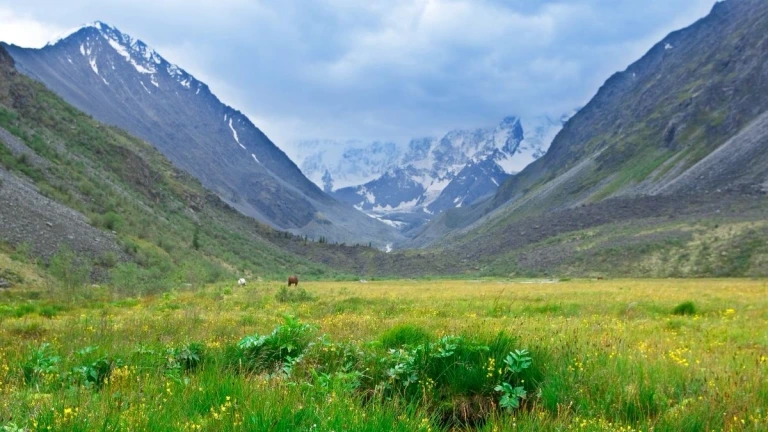
- Mountain Views: The route offers unobstructed views of Ganesh Himal I, II, and IV, Sringi Himal, Boudha Himal, and Himalchuli.
- Ganesh Himal Base Camp: A side trip takes you to the base of the Ganesh Himal range, offering a raw, close-up encounter with the 7,000-meter giants.
- Wildlife Spotting: Due to the ban on hunting, Himalayan Tahr and Blue Sheep are often seen grazing fearlessly near human settlements. With luck, one might even spot a Snow Leopard.
- Tibetan-Style Villages: Villages like Chhokangparo and Nile feature traditional stone houses with slate roofs, interconnected by ancient mani walls and chortens.
- Polyandry Tradition: Tsum Valley is one of the few places in the world where the practice of polyandry (one wife having multiple husbands, usually brothers) is still historically rooted, though modernizing slowly.
Who Is This Trek Right For?
The Tsum Valley Trek is highly recommended if you want to disconnect from the modern world, immerse yourself in Buddhist spirituality, and avoid the crowds of mainstream trekking routes.
We have listed additional criteria below so you can determine whether this trek is a good fit for you:
- Trek Difficulty: Moderate to Challenging. You will walk an average of 6–7 hours per day. While there are no high passes over 5,000m like the Annapurna Circuit, the trails are narrow, rocky, and involve frequent ascents and descents.
- Accommodation: Basic Teahouses. Lodges offer simple twin-sharing rooms. Facilities like attached bathrooms, hot showers, and Wi-Fi are limited or non-existent in upper villages like Mu Gompa.
- Food and Dietary Options: Strictly Vegetarian. As a non-violent zone, meat is generally not available or recommended. You will enjoy fresh, organic locally grown vegetables, Dal Bhat, potatoes, and tsampa (roasted barley flour).
- Age Requirement: No legal age limit. However, due to the remoteness and altitude (up to 3,700m), we recommend children be at least 12 years old and accompanied by a guardian.
- Group Size: Minimum 2 Trekkers. Government regulations strictly require a minimum of two foreign trekkers to issue the Restricted Area Permit. Solo trekking is not permitted.
Tsum Valley Trek Complete Itinerary
This 13-day Tsum Valley itinerary outlines each stage of the trip with elevation details, route segments, and key highlights for every day.
Day 1: Arrival in Kathmandu City
Trekkers arrive at Tribhuvan International Airport (KTM), receive a private hotel transfer, and attend a pre-trek briefing to prepare for the Tsum Valley adventure.
Overview
- Meals Included: None
- Average Elevation: 1,300 meters / 4,265 feet
- Overnight Stay: Kathmandu
Full Description
Upon arrival at the airport, you will complete the on-arrival visa process. After exiting the terminal, our representative will greet you and escort you to your hotel in a private vehicle.
In the evening, a pre-trek briefing will be held. During this session, you will:
- Meet your licensed guide.
- Review the restricted area permit details.
- Check your trekking gear (down jacket, sleeping bag, boots).
- Settle any remaining payments.
This is the ideal time to ensure you have enough cash (NPR) for the trek, as there are no ATMs in Tsum Valley.
Day 2: Drive from Kathmandu to Machha Khola
Trekkers travel 160 kilometers by road from Kathmandu to Machha Khola via Dhading Besi and Arughat. This drive marks the transition from the city to the Budhi Gandaki river valley.
Overview
- Meals Included: Breakfast, Lunch, Dinner
- Endpoint Elevation: 930 meters / 3,051 feet
- Drive Duration: Approximately 8–9 hours
- Route Breakdown: Kathmandu → Dhading Besi → Arughat → Soti Khola → Machha Khola
- Overnight Stay: Machha Khola
Full Description
We begin early with a drive along the Prithvi Highway before turning off towards Dhading Besi. The road from Arughat onwards is off-road and bumpy. We use a sturdy local jeep or bus (depending on group size) to navigate the rough terrain along the Budhi Gandaki River.
You will pass through lush green hills, terraced farms, and waterfalls. By late afternoon, we reach Machha Khola, a small settlement on the riverbank where we spend the night.
Day 3: Trek from Machha Khola to Jagat
Trekkers walk along the river, crossing suspension bridges and passing the natural hot springs at Tatopani.
Overview
- Walking Duration: 6–7 hours
- Endpoint Elevation: 1,340 meters / 4,396 feet
- Overnight Stay: Jagat
- Highlights: Natural hot springs (Tatopani), Dobhan confluence.
Full Description
The trail follows the narrow gorge of the Budhi Gandaki. You will cross the river on a suspension bridge to reach Khorlabesi. Shortly after, you arrive at Tatopani, where natural hot water flows from the cliffside. You can take a brief break here.
Continuing through Dobhan and Yaru Phat, you traverse a cantilever bridge clinging to the cliff face. Finally, you reach Jagat, a beautiful stone-paved village that serves as the entry checkpoint for the Manaslu Conservation Area.
Day 4: Trek from Jagat to Lokpa
Trekkers enter the restricted Tsum Valley today, branching away from the main Manaslu Circuit trail.
Overview
- Walking Duration: 6 hours
- Endpoint Elevation: 2,240 meters / 7,349 feet
- Overnight Stay: Lokpa
- Highlights: First view of Sringi Himal, entering the hidden valley.
Full Description
From Jagat, we trek to Salleri and Sirdibas, enjoying views of Shringi Himal. At Philim, a large Gurung village, we check our permits again.
Just beyond Ekle Bhatti, the trail splits. We take the right-hand path towards Tsum Valley. The trail climbs through a dense forest of pine and rhododendron to reach Lokpa, the first village of the Tsum Valley. The isolation begins to feel real here; the valley narrows, and the silence deepens.
Day 5: Trek from Lokpa to Chumling
Trekkers descend into the deep gorge of the Syar Khola and climb up to the lower Tsum village of Chumling.
Overview
- Walking Duration: 5 hours
- Endpoint Elevation: 2,386 meters / 7,828 feet
- Overnight Stay: Chumling
- Highlights: Views of Ganesh Himal, crossing old suspension bridges.
Full Description
The trail from Lokpa descends steeply into the river gorge. You cross the Lungwa Khola on a bridge and face a challenging zigzag climb through the forest.
As you gain elevation, the white peaks of the Ganesh Himal range reveal themselves. You arrive at Chumling (Lower Tsum), a village known for its three ancient monasteries: Panago Gompa, Mani Dhungyur, and Gurwa Gompa. This is your introduction to the valley’s deep Buddhist roots.
Day 6: Trek from Chumling to Chhokangparo (Upper Tsum)
Trekkers ascend to Upper Tsum Valley, where the landscape opens up into wide, fertile fields surrounded by high peaks.
Overview
- Walking Duration: 5–6 hours
- Endpoint Elevation: 3,031 meters / 9,944 feet
- Overnight Stay: Chhokangparo
- Highlights: Entering Upper Tsum, views of Himalchuli and Ganesh Himal.
Full Description
Today we enter Upper Tsum. The trail passes through Domje and crosses the river again. The climb from Gho to Chhokangparo is steep but rewarding.
“Chhokangparo” translates to “place of wisdom.” As you arrive, the valley widens significantly. Stone houses with slate roofs sit amidst fields of barley, buckwheat, and potato. The Ganesh Himal stands like a wall directly to the east. The air here is thinner, cleaner, and filled with the scent of juniper incense.
Day 7: Trek from Chhokangparo to Nile
Trekkers visit the famous Milarepa’s Cave and the Rachen Gompa nunnery before reaching Nile, the last major village.
Overview
- Walking Duration: 4–5 hours
- Endpoint Elevation: 3,361 meters / 11,026 feet
- Overnight Stay: Nile
- Highlights: Milarepa’s Cave (Piren Phu), Rachen Gompa, Shiar Khola.
Full Description
We take a short detour to visit Piren Phu (Pigeon Cave), one of the most sacred sites in the valley. It is believed the saint Milarepa meditated here. You can see his footprint and ancient murals inside.
We then visit Rachen Gompa, a massive nunnery belonging to the Ngak-pa sect. The trail continues gently upstream along the Shiar Khola to Nile (pronounced Nee-lay). Being the last village before the Tibetan border area, Nile feels remote and timeless.
Day 8: Hike to Mu Gompa and Dhephyudonma Gompa
Trekkers reach the highest point of the trek at Mu Gompa, visiting the oldest monastery in the region.
Overview
- Walking Duration: 4 hours (round trip exploration)
- Endpoint Elevation: 3,700 meters / 12,139 feet
- Overnight Stay: Mu Gompa or Nile (depending on accommodation availability)
- Highlights: Mu Gompa, Dhephyudonma Gompa, yak caravans.
Full Description
We start early for the hike to Mu Gompa, established in 1895. It is perched at 3,700 meters and offers panoramic views of the Tibetan border mountains. You will meet the resident monks and may be offered butter tea.
If time and energy permit, we hike further to Dhephyudonma Gompa, an even older monastery sitting at 4,060 meters. This is the birthplace of the sacred light of Tsum.
We spend the night in the basic monastery guest house (if available) or return to Nile, soaking in the absolute silence of the high Himalayas.
Day 9: Trek from Mu Gompa/Nile to Rachen Gompa and Chhokangparo
We retrace our steps, enjoying a different perspective of the valley as we descend.
Overview
- Walking Duration: 6 hours
- Endpoint Elevation: 3,031 meters / 9,944 feet
- Overnight Stay: Chhokangparo
Full Description
The return journey is easier as we descend. We walk back through Nile and visit Rachen Gompa if we missed it on the way up.
Walking down the valley allows you to appreciate the scale of the Ganesh Himal and Boudha Himal ranges in front of you. We stay overnight again in Chhokangparo, enjoying the hospitality of the Tsumba people.
Day 10: Trek from Chhokangparo to Lokpa
Trekkers say goodbye to Upper Tsum and descend back into the narrow gorge and forest.
Overview
- Walking Duration: 6–7 hours
- Endpoint Elevation: 2,240 meters / 7,349 feet
- Overnight Stay: Lokpa
Full Description
We descend from Chhokangparo to Gho and then down to Domje. The trail drops into the lush vegetation of the lower valley. We cross the Lungwa Khola and climb back up to Lokpa.
Tonight, we celebrate our successful journey to the hidden valley with a warm meal at the lodge.
Day 11: Trek from Lokpa to Jagat
We rejoin the main Manaslu trail and head south.
Overview
- Walking Duration: 7 hours
- Endpoint Elevation: 1,340 meters / 4,396 feet
- Overnight Stay: Jagat
Full Description
Leaving the restricted Tsum Valley area, we descend through the forest to Philim. The trail becomes busier as we merge with trekkers heading to the Manaslu Circuit. We continue down to Sirdibas and Jagat, revisiting the beautiful stone-paved village.
Day 12: Trek to Machha Khola and Drive to Kathmandu
A short trek followed by a long drive back to the capital.
Overview
- Walking Duration: 3 hours
- Drive Duration: 7–8 hours
- Endpoint Elevation: 1,300 meters / 4,265 feet
- Overnight Stay: Kathmandu
Full Description
We trek from Jagat down to Machha Khola (or take a local jeep from Jagat if the road condition permits). From Machha Khola, our private vehicle will pick us up for the drive back to Kathmandu.
Upon arrival, you are transferred to your hotel. In the evening, we host a Farewell Dinner to celebrate your journey.
Day 13: Departure
Meals Included: Breakfast
Today, you bid farewell to Nepal. Our representative will transfer you to the airport 3 hours before your flight. You leave with the blessings of the Tsum Valley and memories of a lifetime.
Cost Inclusion & Exclusion
Included Service & Amenities
- Airport Transfer: Private pickup and drop-off.
- Transportation: Kathmandu to Machha Khola and return by private Jeep (for groups) or comfortable local bus.
- Accommodation: 3-Star Hotel in Kathmandu (2 nights, twin-sharing, B&B) and basic teahouses during the trek.
- Permits:
- Manaslu Conservation Area Permit (MCAP)
- Tsum Valley Restricted Area Permit (RAP)
- Guide: Government-licensed English-speaking trekking guide (salary, food, insurance, gear included).
- Porter: 1 porter for every 2 trekkers (max weight 25kg).
- Trekking Gear: Duffel bag, sun hat, and trekking map (yours to keep).
- Emergency: 24/7 ground support and rescue coordination assistance.
- Taxes: All government and local taxes.
Excluded From The Package
- International Airfare and Nepal Visa fees.
- Trekking Meals: Breakfast, lunch, and dinner during the trek (budget approx. USD 25–30 per day). Note: This allows you flexibility to choose your own meals.
- Travel Insurance: Mandatory (must cover helicopter evacuation up to 4,000m).
- Personal Expenses: Wi-Fi, hot showers, battery charging, boiled water, beverages.
- Tips: Recommended for guide and driver (customary in Nepal).
Facilities Available During the Trek
Facilities in Tsum Valley are basic yet authentic. Trekkers stay in traditional stone houses and enjoy organic local food.
Lodging Standards
- Teahouses: Most are family-run homestays. Rooms are simple with wooden beds, foam mattresses, and blankets.
- Toilets: Shared squat toilets are the standard. Bring your own toilet paper.
- Heating: No heating in rooms. The communal dining hall is heated by a wood-burning stove in the evenings.
- Electricity: Available in lower villages (hydro/solar). Charging is often paid (approx. NPR 200–500 per device).
Food & Dietary Options
- Strictly Vegetarian: Tsum Valley is a no-kill zone. Do not ask for chicken or buffalo meat.
- Menu Items: You will find Dal Bhat (lentil soup, rice, curry), Tibetan Bread, Tsampa Porridge, Thukpa (noodle soup), and MoMos (vegetable/cheese).
- Water: Tap water is not safe. Use water purification tablets, a filter bottle, or buy boiled water from lodges.
Best Time to Trek Tsum Valley
Spring (March to May) and Autumn (September to November) are the two best seasons.
Autumn (September – November)
- Best Visibility: The monsoon washes away dust, offering crystal-clear mountain views.
- Festivals: Experience local festivals and harvest activities.
- Weather: Stable and dry. Daytime 10°C to 18°C; Nights drop to -5°C.
Spring (March – May)
- Flora: Rhododendrons bloom in the lower forests (Lokpa/Chumling area).
- Wildlife: Animals like Himalayan Tahr are more active after winter.
- Weather: Warmer days, but haze may obscure distant peaks in the afternoon.
Winter Note: Trekking in winter (Dec-Feb) is possible but challenging. Many teahouses close as locals migrate down. Heavy snow can block the trail to Mu Gompa.
Wildlife in Tsum Valley
Because of the Shagya tradition (ban on hunting), wildlife in Tsum is remarkably fearless.
- Himalayan Tahr & Blue Sheep: Frequently seen on rocky cliffs near Chhokangparo and Nile.
- Birds: Himalayan Monal (Danphe), Tibetan Snowcock, and Griffon Vultures.
- Snow Leopard: The “Ghost of the Mountains” inhabits the high ridges but is rarely seen.
- Red Panda: Inhabits the bamboo forests near Lokpa and Chumling.
Key Points to Know Before Trekking
- Restricted Area: You cannot trek alone. A guide and a partner are mandatory.
- Cash is King: Bring enough NPR from Kathmandu.USD is not accepted in small teahouses.
- Respect the Culture: Walk clockwise around chortens and mani walls. Do not kill insects or animals.
- Connectivity: Mobile signal (Ncell/Namaste) is sporadic. Do not rely on it for work.
Packing Guide (Specific for Tsum)
In addition to standard trekking gear, Tsum Valley requires:
- conservative clothing: To respect the monastic culture (shoulders and knees covered).
- Power bank: 20,000mAh recommended due to limited electricity.
- Snacks: Energy bars/chocolate (shops are scarce in Upper Tsum).
- Headlamp: For dark teahouse corridors and early starts.
Trekkers Reviews
Name: Sarah Jenkins
“The peace in Tsum Valley is unlike anything else. Watching the monks at Mu Gompa chant while the wind howled outside was a spiritual reset for me. Travel To Nepal arranged everything perfectly, and our guide, Pasang, knew every story about the valley.”
Name: Mark & David
“We wanted to avoid the crowds of Annapurna, and Tsum delivered. It’s raw and basic—don’t expect luxury—but the hospitality of the Tsumba people warms you up. The view of Ganesh Himal from Chhokangparo is etched in my memory forever.